
Mounjaro in Japan: A Guide for Foreign Residents
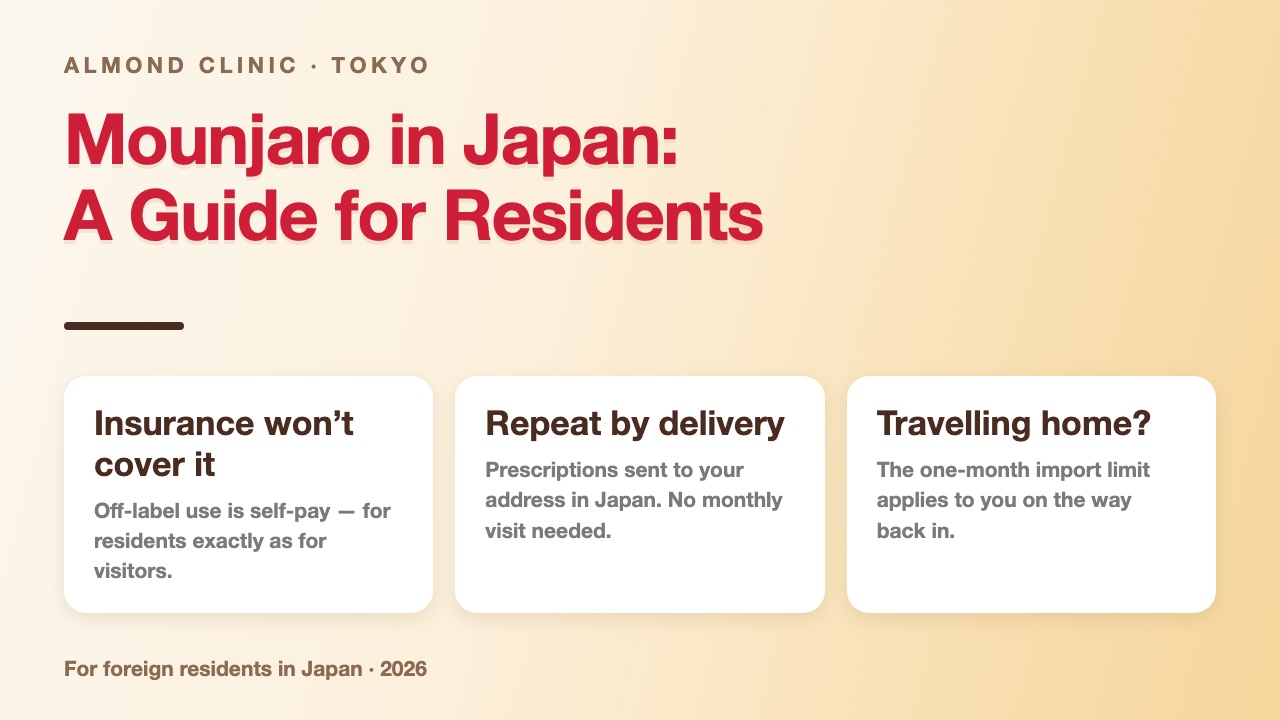
The short version
- Your Japanese health insurance will not cover this. Using Mounjaro for weight management is off-label and self-pay — for residents exactly as for visitors.
- That also means you are not at any disadvantage. You pay the same as anyone else, and your insurance card is not involved.
- Repeat prescriptions can be delivered to your address in Japan, so you do not have to come in every month.
- Going home for the holidays? The one-month import limit applies to you on the way back in, just as it does to a tourist.
Most English-language writing about GLP-1 medicines in Japan is aimed at tourists. If you actually live here, the questions are different: what your insurance does and does not do, how to keep a prescription running month after month, and what happens when you leave the country and come back. This page is for you.
Why your insurance card does not help here
Japan’s public health insurance is generous, and if you are enrolled in it you are used to paying 30% of the cost of most things. It is a reasonable assumption that the same would apply here. It does not.
In Japan, Mounjaro is approved as a treatment for type 2 diabetes. If you are being treated for diabetes, that is insured care and your card applies. Using it for weight management is off-label, and off-label use falls outside the insurance system entirely. It is self-pay — you pay 100%, at the clinic’s own price rather than a nationally set one.
Two consequences follow, and both are worth understanding before you start:
- Prices vary between clinics, because there is no national price for self-pay care. Ours are published further down this page.
- Self-pay treatment is not eligible for Japan’s national relief system for adverse drug reactions (医薬品副作用被害救済制度). That is a real trade-off, and you should know about it rather than discover it later.
The flip side is the one piece of good news in this section: because no insurance is involved either way, your residency status makes no difference to what you pay or how you are treated. A resident, a student on a visa and a tourist are all in the same position.
Keeping a prescription running
This is the practical difference between living here and visiting. A tourist needs one supply; you need a supply that continues.
- Repeat prescriptions can be handled through our official WhatsApp or LINE account, with the medicine delivered to your address in Japan. Delivery is a flat JPY 1,000 (≈ USD 6).
- Doses usually step up over the first months. Almost everyone starts at 2.5 mg. Because the price rises with the dose, your monthly cost is likely to change as you go — plan for that rather than budgeting from the starting figure.
- A three-month plan is available at a lower monthly rate than buying month by month, if you are settled on a dose.
- Keep the conversation going. If something is not sitting well — nausea that is not settling, a dose that feels wrong — message the doctor rather than stopping quietly.
What it costs
Prices in Japanese yen, tax included. The consultation is free (JPY 0). One pen covers one week, so a month is four pens. US dollar figures are approximate, for orientation only, at USD 1 ≈ JPY 159 (24 August 2026).
| Item | 1 month (4 pens) | 3-month plan (12 pens) |
|---|---|---|
| Mounjaro 2.5 mg | JPY 16,500 / month ≈ USD 104 | JPY 46,500 (JPY 15,500 / month) ≈ USD 292 |
| Mounjaro 5 mg | JPY 28,000 / month ≈ USD 176 | JPY 81,000 (JPY 27,000 / month) ≈ USD 509 |
| Mounjaro 7.5 mg | JPY 40,000 / month ≈ USD 251 | JPY 117,000 (JPY 39,000 / month) ≈ USD 735 |
| Mounjaro 10 mg | JPY 49,000 / month ≈ USD 308 | JPY 144,000 (JPY 48,000 / month) ≈ USD 905 |
| Mounjaro 12.5 mg | JPY 58,000 / month ≈ USD 364 | JPY 171,000 (JPY 57,000 / month) ≈ USD 1,074 |
| Mounjaro 15 mg | JPY 68,000 / month ≈ USD 427 | JPY 201,000 (JPY 67,000 / month) ≈ USD 1,263 |
| Delivery within Japan | JPY 1,000 ≈ USD 6 | — |
| Prescription certificate in English | JPY 3,000 ≈ USD 19 | — |
Leaving Japan and coming back
Here is the point that catches residents out, and it is worth reading twice.
Japan’s import allowances are about what is brought into the country, not about who is carrying it. A residence card does not exempt you. If you go home for two weeks and come back with three months’ supply bought abroad, you are over the limit in exactly the way a tourist would be, and you would need an import certificate (Yakkan Shoumei) obtained before you flew.
The reverse direction matters too. If you are taking your Japanese-bought medicine abroad on holiday, the destination country’s rules apply — and an English prescription certificate is what every border asks for. We can issue one for JPY 3,000 (≈ USD 19); have your home address in English ready, because it goes on the document.
- Coming into Japan: Can you bring Mounjaro into Japan?
- Going out of Japan: Taking Mounjaro home from Japan — covers Singapore, the US, UK, Australia, Canada and the EU.
Important safety information
The most common side effects are gastrointestinal: nausea, vomiting, diarrhoea, constipation, reduced appetite and abdominal discomfort. These are usually mild to moderate and tend to ease within a few weeks as the body adjusts to the medicine or to a higher dose. Rare but important side effects include acute pancreatitis and gallbladder disease, and low blood sugar can occur when it is used with other glucose-lowering medicines. If you develop severe, persistent abdominal pain, stop using it and seek medical attention.
It is not suitable for everyone. It should not be used by anyone who is pregnant, planning a pregnancy or breastfeeding; anyone with a personal or family history of medullary thyroid carcinoma or with multiple endocrine neoplasia syndrome type 2; or anyone who has had a serious allergic reaction to any ingredient. Tell the doctor if you have a history of pancreatitis or severe gastrointestinal disease, and about any other medicines you take.
FAQ
- Can I use my Japanese health insurance card?
-
Not for weight management. That use is off-label and self-pay, which sits outside the insurance system. Your card would apply if you were being treated for type 2 diabetes, which is a different situation and a different conversation with a doctor.
- Do I need to come to the clinic every month?
-
No. After the first consultation, repeat prescriptions can be arranged through WhatsApp or LINE and delivered to your address in Japan for a flat JPY 1,000. Come in when it suits you, or when the doctor wants to review how you are getting on.
- I already get it from a clinic in my home country. Can I just keep using that?
-
You can carry in one month’s supply each time you enter Japan without paperwork. Beyond that you need an import certificate issued before departure, and having it posted to you from abroad is treated as importing rather than as personal luggage. For most residents it becomes simpler to be prescribed here.
- Does the consultation have to be in Japanese?
-
No. An English interpreter on our staff joins the consultation when available; otherwise we use a voice-translation tool, and staff will help you with the questionnaire. You do not need any Japanese, and you do not need to bring an interpreter.
- Is this tax-deductible in Japan?
-
Japan’s medical expense deduction generally applies to treatment of illness rather than to treatment for appearance, and how it applies depends on your own circumstances. This is a question for a tax professional or your local tax office, not for us — we would rather say so than guess.
This article is general information, not medical advice. Whether Mounjaro is appropriate for you is a decision for a doctor who has assessed you.
Related reading
- Mounjaro in Japan — our main page: full price list, the Tokyo clinic, online prescription and delivery.
- Where to get Mounjaro in Tokyo as a visitor — what to bring, and what it costs.
- Can you bring Mounjaro into Japan? — the one-month rule and the Yakkan Shoumei.
- Taking Mounjaro home from Japan — the rules for six destinations.
- Mounjaro side effects and the first month — what to expect, and when to stop and get seen.
- Travelling with Mounjaro — storage, flights, hotel fridges and time zones.
