
Can You Bring Mounjaro Into Japan? Rules for Travellers (2026)
The short version
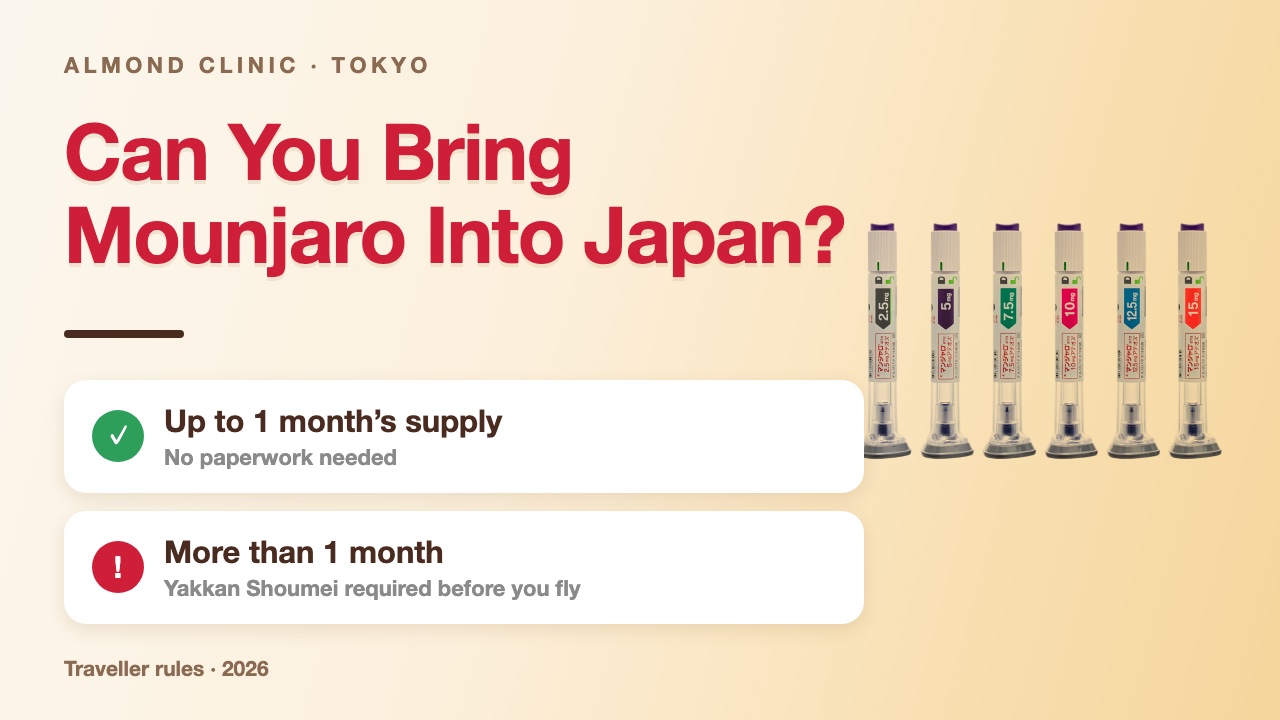
- Up to one month’s supply: no paperwork. Carry it in your hand luggage with the box, label and prescription.
- More than one month: you need a Yakkan Shoumei — an import certificate that must be issued before you leave home. It is free, but it cannot be arranged at the airport.
- Staying longer than your supply? Mounjaro is prescribed in Japan, so a long trip does not have to mean a bigger suitcase.
If you already take Mounjaro and you are travelling to Japan, the question is a practical one: how much can you bring, and does it need paperwork? This guide sets out exactly where the line falls, how to apply if you cross it, how to pack the pens for the flight, and what your options are if your trip lasts longer than the supply you can carry.

Dr. Itsuki Nakayama · Medical Director, Almond Clinic
We dispense genuine brand-name medicine obtained through Japan’s regular pharmaceutical distribution channels.
The rule, in Japan’s own words
Bringing medicine into Japan is controlled by the Pharmaceuticals and Medical Devices Act and the Customs Act. The Ministry of Health, Labour and Welfare (MHLW) publishes the allowances in English, and two lines of that table describe Mounjaro:
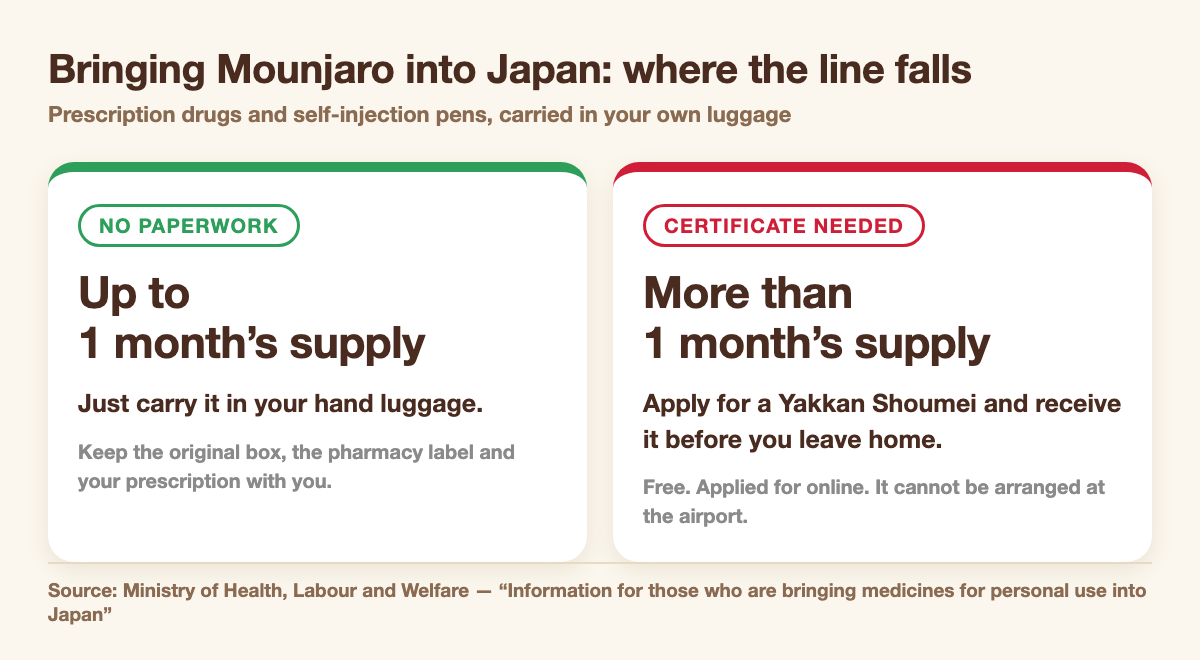
Poison, Deadly poison, Prescription drug : Up to 1 month supply
Injectable drug and Syringe for the drug: Up to 1 month supply * Only “Pre-filled Syringe” or “Self-injection Kit”
Mounjaro is a prescription medicine supplied as a single-use prefilled pen, so both lines describe it — and both set the same ceiling of one month.
Stay under that ceiling and, in the ministry’s words, “you do not have to apply for Import Confirmation.” Go over it and “you have to apply for Import Confirmation, and receive it before you leave home, and show it to the officer at customs.”
The current text is on the MHLW page Information for those who are bringing medicines for personal use into Japan. Rules change, so please check it yourself before you travel.
What counts as “one month’s supply”?
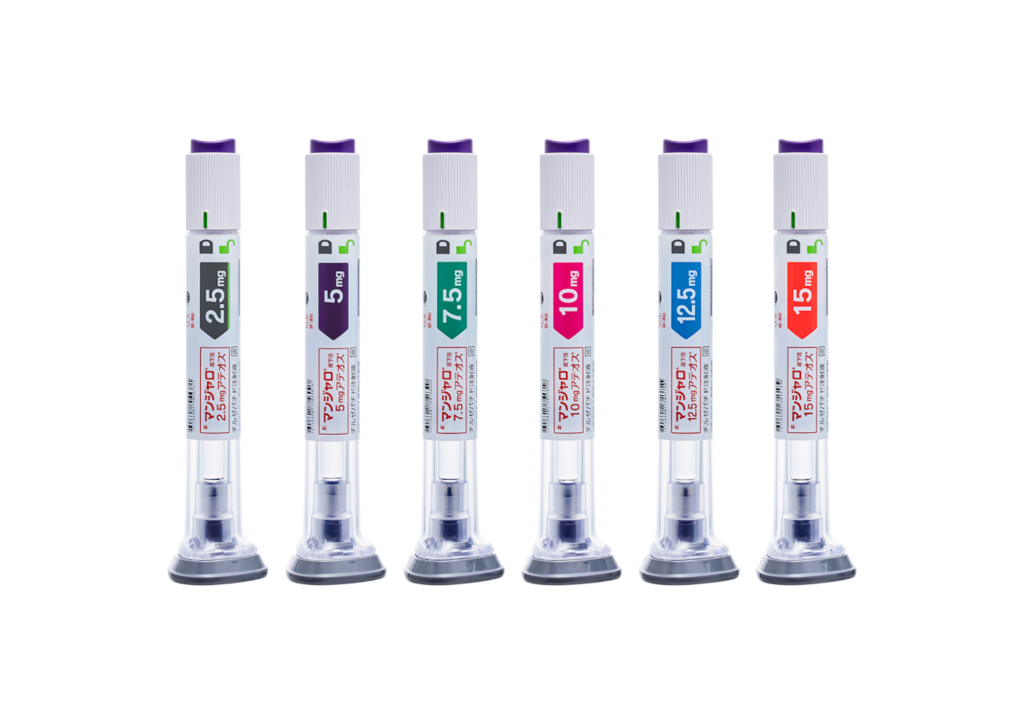
Mounjaro is injected once a week, so a month is normally four pens. There is no fixed pen count in the rules, though: the quantity is judged against the dose written on your prescription or pharmacy label.
If your prescription says 5 mg once weekly, four 5 mg pens read as one month. Eight pens read as two months, and that needs a certificate.
- It is the amount you carry that counts, not the amount you expect to use while in Japan.
- Different strengths are added together — two 2.5 mg pens plus four 5 mg pens is six weeks, not one month.
- Keep the pharmacy label on the box and carry your prescription, so an officer can check the dose quickly if asked.
If you need more than a month: the Yakkan Shoumei
A Yakkan Shoumei (import confirmation certificate) is issued by a Regional Bureau of Health and Welfare. It is free, and you can now apply online in English through the ministry’s Application for Import Confirmation system.
Three points catch people out:
- It has to be issued before you leave home. This is not something you can sort out at the airport or after you land, so leave yourself several weeks.
- Your luggage has to match the certificate. It is valid only when the contents are the same as those written on it.
- Never write on it or amend it. A corrected certificate is treated as invalid.
Questions about the certificate go to the regional bureau for your port of entry — for Tokyo and most of eastern Japan that is the Kanto-Shinetsu bureau (yakkan@mhlw.go.jp), and for the Osaka area the Kinki bureau (kiyakuji@mhlw.go.jp).
How to pack Mounjaro for the flight
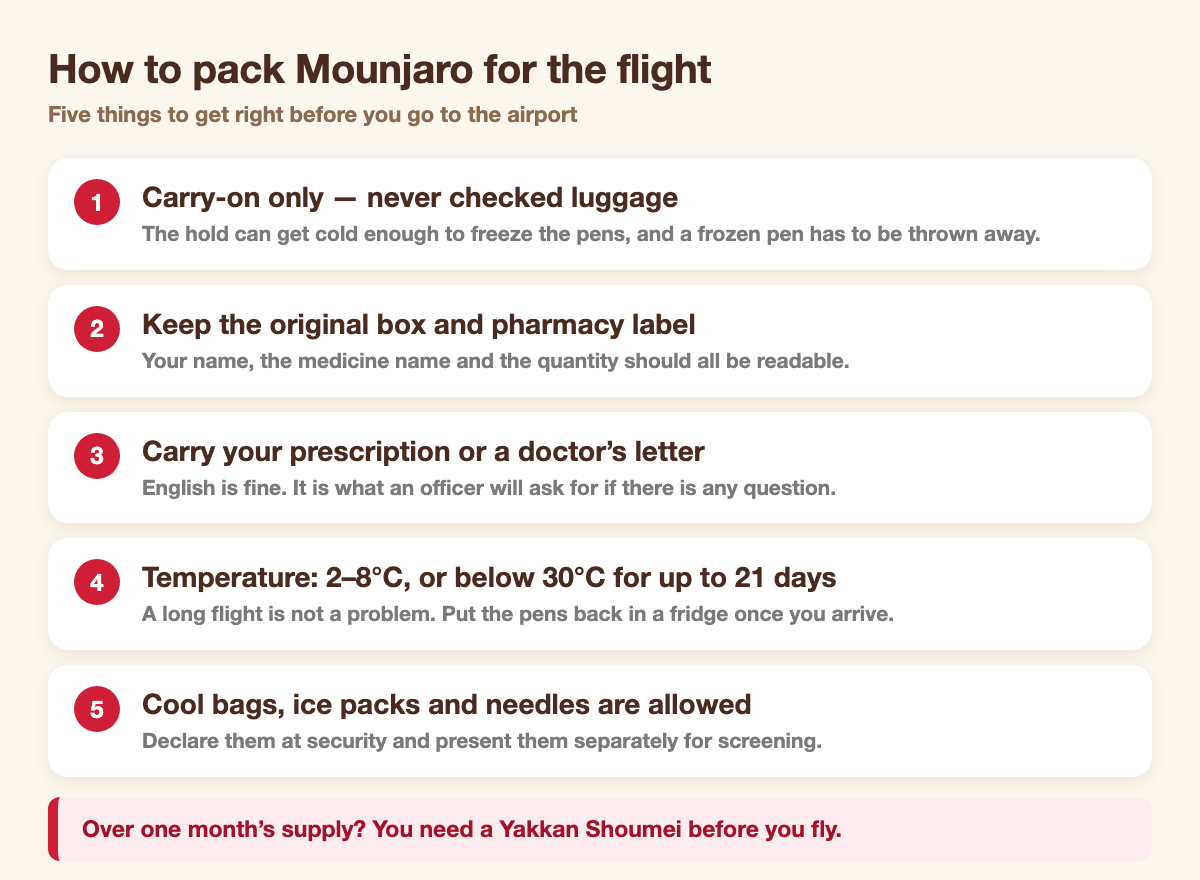
- Carry-on only. Never put the pens in checked luggage. The hold can get cold enough to freeze the medicine, and a frozen pen must be thrown away.
- Keep the original box and pharmacy label with your name, the medicine name and the quantity on it.
- Carry your prescription or a doctor’s letter. English is fine.
- Temperature. Mounjaro is normally kept refrigerated at 2–8°C, and may be kept below 30°C for up to 21 days in total. A long flight is therefore not a problem in itself — put it back in the fridge when you arrive.
- Cool bags and ice packs are allowed through airport security as medically necessary items, but declare them and present them separately for screening. Needles are fine when carried with the medicine they belong to.
What if your trip is longer than your supply?
You have three realistic options.
- Apply for the Yakkan Shoumei before you fly. Free, but it needs planning and it has to be in your hand before departure.
- Bring one month and pick up the rest in Japan. Mounjaro is prescribed here, so a longer stay does not have to mean a bigger suitcase.
- Get it prescribed in Japan. Useful if you only realise the problem after you arrive, or if your travel dates move.
At Almond Clinic in Ichigaya, central Tokyo, Mounjaro is prescribed by a doctor, with an English interpreter on our staff joining the consultation when available (otherwise we use a voice-translation tool). The consultation is free, and you can either collect the medicine at the clinic the same day or have an online consultation and receive it at your hotel.
What Mounjaro costs at our clinic in Tokyo
These are our own prices, in Japanese yen, tax included. The consultation itself is free (JPY 0), and one pen covers one week, so a month is four pens. The US dollar figures are approximate, for orientation only — you pay in yen, and the rate moves. They are worked out at USD 1 ≈ JPY 159 (24 August 2026).
| Item | 1 month (4 pens) | 3-month plan (12 pens) |
|---|---|---|
| Mounjaro 2.5 mg | JPY 16,500 / month ≈ USD 104 | JPY 46,500 (JPY 15,500 / month) ≈ USD 292 |
| Mounjaro 5 mg | JPY 28,000 / month ≈ USD 176 | JPY 81,000 (JPY 27,000 / month) ≈ USD 509 |
| Mounjaro 7.5 mg | JPY 40,000 / month ≈ USD 251 | JPY 117,000 (JPY 39,000 / month) ≈ USD 735 |
| Mounjaro 10 mg | JPY 49,000 / month ≈ USD 308 | JPY 144,000 (JPY 48,000 / month) ≈ USD 905 |
| Mounjaro 12.5 mg | JPY 58,000 / month ≈ USD 364 | JPY 171,000 (JPY 57,000 / month) ≈ USD 1,074 |
| Mounjaro 15 mg | JPY 68,000 / month ≈ USD 427 | JPY 201,000 (JPY 67,000 / month) ≈ USD 1,263 |
| Prescription certificate in English (English medical certificate / proof of prescription) | JPY 3,000 ≈ USD 19 | — |
A few notes. An English prescription certificate costs JPY 3,000 and is worth having if you expect to be asked about the medicine on the way home. If you choose the online route and have the medicine delivered, there is a flat delivery fee of JPY 1,000 (≈ USD 6) anywhere in Japan. Payment is by cash or credit card at the clinic, or by card online.
Full details of both routes — visiting the clinic and online with hotel delivery — are on our Mounjaro in Tokyo page, and the booking screens are shown step by step in the English booking guide.
Important things to know about Mounjaro in Japan
In Japan, Mounjaro is approved as a treatment for type 2 diabetes. Using it for weight management is off-label use and is provided as self-pay (non-insured) care, so it is not covered by Japanese public health insurance and not eligible for the national relief system for adverse drug reactions. It is prescribed only after a doctor has assessed you.
The most common side effects are gastrointestinal: nausea, vomiting, diarrhoea, constipation, reduced appetite and abdominal discomfort. These are usually mild to moderate and tend to ease within a few weeks as the body adjusts. Rare but important side effects include acute pancreatitis and gallbladder disease, and low blood sugar can occur when Mounjaro is combined with other glucose-lowering medicines. If you develop severe, persistent abdominal pain, stop using it and seek medical attention.
Mounjaro is not suitable for everyone. It should not be used by anyone who is pregnant, planning a pregnancy or breastfeeding; anyone with a personal or family history of medullary thyroid carcinoma or with multiple endocrine neoplasia syndrome type 2; or anyone who has had a serious allergic reaction to any ingredient. Tell the doctor at your consultation if you have a history of pancreatitis or severe gastrointestinal disease.
Why the price of Mounjaro is different in each country
Mounjaro is the same medicine wherever it is dispensed. What a patient actually pays, however, is decided by things that have little to do with the medicine itself:
- Whether it is covered. Where the medicine is reimbursed for a particular diagnosis, the patient pays only a share of the cost. Use for weight management is commonly outside that cover and is paid for privately.
- How prices are set. Japan sets a single official price for medicines dispensed under public health insurance. The United States has a manufacturer list price, after which what a patient pays depends on their insurance, the pharmacy and any discount programme. In Singapore, tirzepatide is a prescription-only medicine that is not subsidised under public schemes, so each clinic sets its own fee.
- The dose. Prices rise with dose almost everywhere.
- The exchange rate, which moves from day to day.
Published figures: the United States figure is as shown on Lilly’s pricing page in October 2026; the others are as of August 2026. US dollar equivalents are approximate, at the rates on 24 August 2026. Our own fees by dose, and what they include, are set out in Mounjaro price in Japan.
| Country | Published figure | What the figure is |
|---|---|---|
| United States | USD 1,112.16 per fill | Eli Lilly’s published list price. Lilly states that the amount a patient pays depends largely on their prescription drug insurance plan. |
| United States (self-pay) | See Lilly’s current terms | Lilly states that patients whose insurance does not cover Mounjaro, or who have no insurance, may be eligible for self-pay savings options; terms and conditions apply. |
| Singapore | Around SGD 400–1,200 per month ≈ USD 315–945 | Not an official price. A range published by private clinics, varying by dose. Consultations are normally charged separately (commonly SGD 80–150, ≈ USD 63–118). |
| Japan | Set by each clinic Our own fees: JPY 16,500–68,000 per month ≈ USD 104–427 | Approved for type 2 diabetes. Use for weight management is off-label and self-pay, so each clinic sets its own fee and other clinics will differ. The figure shown is our own, by dose; the full table is earlier in this article. |
Two things are worth stating plainly about that table.
The figures are not like-for-like. A manufacturer’s list price is not what most patients hand over at the counter; Lilly itself notes that the amount a patient pays depends on their insurance and on discount programmes, and that many insured patients pay considerably less than the list price. Singapore has no published national price, only the fees individual clinics advertise. And in Japan the figure depends entirely on which clinic you attend.
The US dollar figures are approximate and are there only to give you a common yardstick. They are worked out at the rates on 24 August 2026 (USD 1 ≈ JPY 159; SGD 1 ≈ USD 0.79). Exchange rates move daily, and the rate your own bank or card gives you will differ, so treat them as a rough orientation rather than a quote.
Sources: Eli Lilly pricing information for Mounjaro (pricinginfo.lilly.com); fees published by private clinics in Singapore. Prices change frequently — please check the current position for yourself before making any decision.
FAQ
- How do prices in Japan compare with the United States or Singapore?
-
The published figures for each country are set out in the section above, together with what each figure actually represents. They are not directly comparable: a manufacturer’s list price, a self-pay price and a private clinic’s fee are three different things, and the exchange rate moves. What you would pay at home depends on your dose and on whether you have any cover for it. We can only quote our own fees, which are in the price table earlier in this article.
- Do I have to declare Mounjaro at Japanese customs?
-
If you are within the one-month allowance and carrying it for your own use, there is normally nothing to apply for in advance. If an officer asks what you are carrying, answer honestly and show the box and your prescription. If you are carrying more than a month’s supply, you must show your Yakkan Shoumei at customs.
- Is it the same for Ozempic, Wegovy and other GLP-1 pens?
-
Yes. The allowance is set by category, not by brand: a prescription medicine supplied as a prefilled syringe or self-injection kit is limited to one month’s supply without an import certificate. That covers the other GLP-1 pens as well as Mounjaro.
- Can I post my medicine to my hotel in Japan instead of carrying it?
-
Sending medicine to yourself from abroad is treated as an import rather than as personal luggage, and the exemptions above are written for medicines you carry with you. It is considerably more complicated than simply bringing the pens in your hand luggage, and parcels can be held at customs. If you are considering it, ask MHLW first.
- Can I bring spare needles?
-
Yes. Needles and syringes for the medicine you are carrying are treated together with it. Keep them in your carry-on with the pens and the pharmacy label.
- I live in Japan. Do the same limits apply when I come back from a trip?
-
The allowances are about what is brought into the country, not about who is carrying it, so the same one-month limit applies. Residents who need a longer supply from abroad go through the same Import Confirmation process.
In short
One month or less, carried in your hand luggage with its label and your prescription: no paperwork. More than a month: apply for a Yakkan Shoumei and have it before you fly. And if the paperwork is more trouble than it is worth, Mounjaro can simply be prescribed while you are in Tokyo.
This article is general information, not medical advice, and immigration and customs rules can change at any time. Please confirm the current requirements with the Ministry of Health, Labour and Welfare before you travel.
Related reading
- Mounjaro in Japan — our main page: full price list, the Tokyo clinic, online prescription and delivery.
- Mounjaro price in Japan — what each dose costs per month, and what is included.
- How to use the Japanese Mounjaro pen — three steps, and how it differs from the KwikPen.
- Mounjaro outside Tokyo — Osaka, Kyoto, Fukuoka, Okinawa and Sapporo by online consultation and hotel delivery.
- Where to get Mounjaro in Tokyo as a visitor — what to bring, and what it costs.
- Taking Mounjaro home from Japan — the rules for six destinations.
- Is Mounjaro right for you? — who it is not for, and what to tell the doctor.
- Travelling with Mounjaro — storage, flights, hotel fridges and time zones.
Dr. Itsuki Nakayama · Medical Director, Almond Clinic
We dispense genuine brand-name medicine obtained through Japan’s regular pharmaceutical distribution channels.
Already decided? See the step-by-step booking guide in English.
