
Taking Mounjaro Home From Japan: Seven Countries’ Rules
The short version
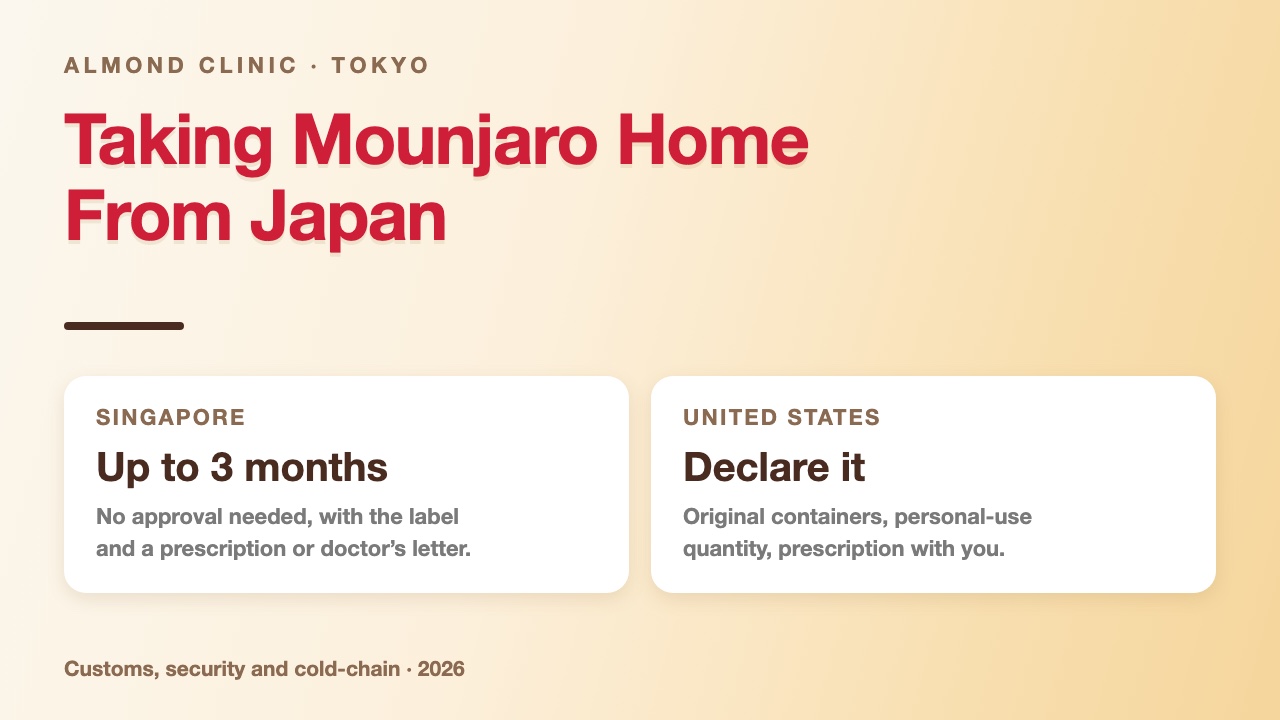
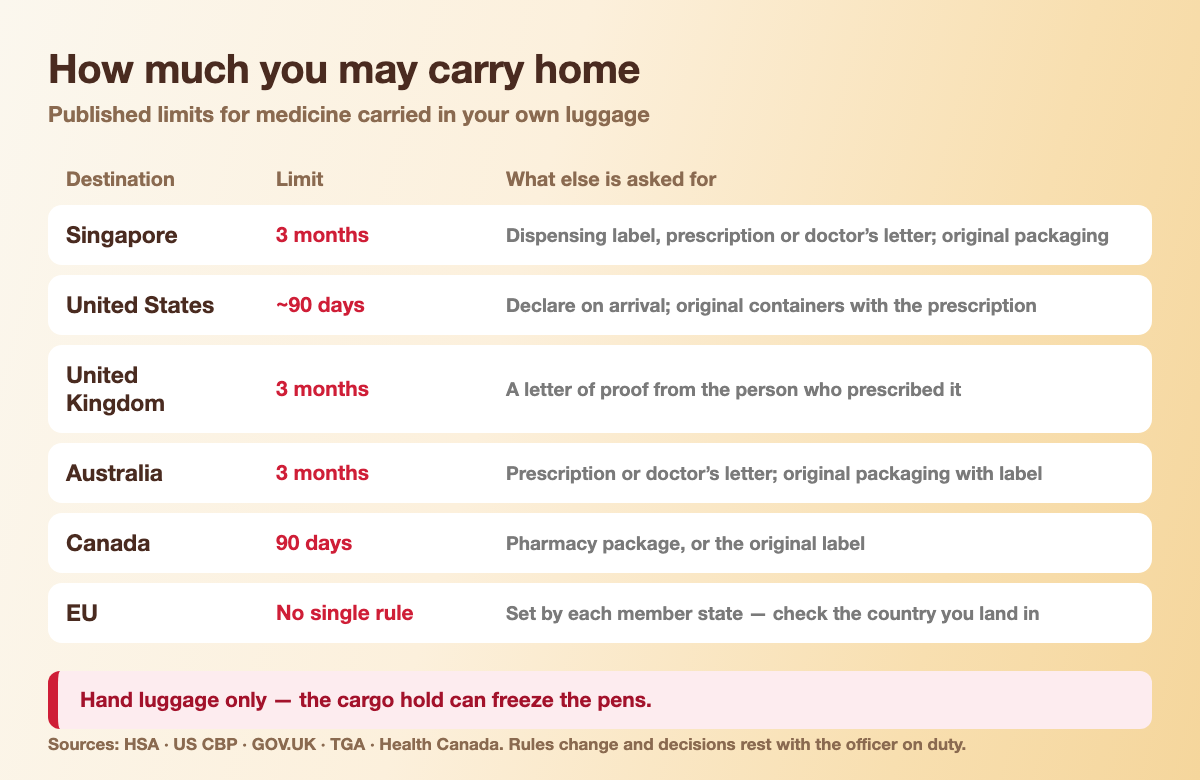
- Singapore: up to 3 months’ supply without approval, provided you carry the dispensing label or a prescription or doctor’s letter, and the medicine is in its original labelled packaging.
- United States: declare it. Keep it in its original container with the prescription, carry no more than personal-use quantities (a rule of thumb is 90 days), and note that only medicines that can legally be prescribed in the US may be imported for personal use — which tirzepatide can.
- UK, Australia, Canada: three months, three months, and 90 days respectively — each with a prescription or doctor’s letter. The EU has no single rule; check the country you land in.
- Everywhere: hand luggage, never the hold. Original packaging. An English prescription certificate makes every conversation shorter.
Getting Mounjaro prescribed in Tokyo is the easy part. The question people actually worry about is the flight home — whether it will be taken off them at the border, and what they are supposed to show. This page covers the rules for Singapore and the United States, and the general principles that apply wherever you are going.

Dr. Itsuki Nakayama · Medical Director, Almond Clinic
We dispense genuine brand-name medicine obtained through Japan’s regular pharmaceutical distribution channels.
The three things that matter everywhere
Border rules differ in their detail, but the same three things decide how the conversation goes.
- Is it obviously yours, and obviously medicine? Original box, pharmacy label with your name on it, quantity visible.
- Can you show it was prescribed? A prescription, a doctor’s letter, or a prescription certificate — in English.
- Is the quantity sensible for one person? Personal-use amounts pass easily. Large quantities invite questions everywhere.
And one rule about the flight itself: keep the pens in your hand luggage. The cargo hold can get cold enough to freeze them, and a frozen pen has to be thrown away.
Singapore
Singapore’s Health Sciences Authority (HSA) publishes clear limits for personal medication brought in by travellers.
You may bring up to 3 months’ supply if no approval is needed and the medication is not prohibited.
Alongside the quantity, HSA asks you to “provide pharmacy dispensing labels, doctor’s prescription, or doctor’s letter”, and states that “each medication should be in their original container/packaging and also labelled with the patient name, medication name and quantity”.
Two further points:
- Medicines containing controlled substances need approval in advance. Tirzepatide is a prescription-only medicine in Singapore rather than a controlled drug, but if you are carrying anything else, check HSA’s list.
- Where an approval is needed, HSA asks you to “submit your application at least 2 weeks before your arrival in Singapore”.
The current guidance is on the HSA page Travelling with medications to Singapore.
United States
US Customs and Border Protection (CBP) asks travellers to declare all medicines and similar products on arrival. Beyond that, the guidance is about documentation and quantity:
- Original containers with the prescription printed on them. If the medicine is not in its original container, carry a copy of the prescription or a letter from your doctor.
- Personal-use quantities only. CBP gives a rule of thumb of no more than a 90-day supply.
- Only medicines that can legally be prescribed in the United States may be imported for personal use. Tirzepatide is approved and prescribed in the US, so it meets that test.
For the flight, the Transportation Security Administration (TSA) treats injectable medicines, needles and medically necessary gel ice packs as permitted in carry-on baggage. They are exempt from the usual liquid limits when carried in reasonable quantities and declared for separate screening, so take them out of your bag and tell the officer before screening starts.
Current guidance: CBP — Traveling with Medication to the United States and TSA — Medications (liquid).
One honest caveat. The decision at the border always rests with the officer on duty. Documentation and sensible quantities make the process straightforward; they are not a guarantee, and no clinic can give you one.
United Kingdom
The UK publishes a clear limit for medicine carried in for personal use:
- Up to three months’ supply. Beyond that you would need to apply for a personal licence, and only in exceptional circumstances.
- Carry a letter of proof from the person who prescribed it. GOV.UK states this plainly as the way to stop your medicine being taken from you at the border — which is exactly what our English prescription certificate is for.
- Different rules apply to controlled drugs. Tirzepatide is not one, but if you are carrying anything else, check.
Current guidance: GOV.UK — Take medicine in or out of the UK.
Australia
Australia has a specific provision for this situation, called the traveller’s exemption. Under it you may carry in up to three months’ supply of a medicine for your own use, without seeking permission in advance.
- Carry the prescription or a letter from your doctor setting out what you are taking and how much.
- Keep the product in its original packaging with the dispensing label, so it can be identified easily.
- The exemption is for you or an immediate family member travelling with you. You may not supply it to anyone else.
Current guidance: TGA — Entering Australia.
Canada
- A personal quantity — a 90-day supply, or a single course of treatment.
- The product must be in the package dispensed by the pharmacy, or carry the original label saying clearly what it is and what it contains.
- Visitors staying longer than three months may receive a further 90-day supply every three months by mail or courier.
Current guidance: Health Canada — Bringing health products into Canada for personal use.
The European Union
This is the one place where a simple answer does not exist. There is no single EU-wide rule for bringing prescription medicine in from outside the bloc — each member state sets its own quantity limits and documentation requirements, and they differ.
The Schengen certificate that people sometimes mention is for controlled substances, and tirzepatide is not one, so it does not apply here. What does apply is the ordinary advice: carry the original packaging, the pharmacy label and a prescription certificate in English, keep the quantity to what one person would plausibly use, and check the rules of the country you are actually landing in — not the EU as a whole.
The Philippines
Mounjaro is registered with the Philippine FDA and sold in major pharmacy chains on prescription (as the four-dose KwikPen, roughly ₱10,900–13,600 for 2.5 mg and 5 mg as of 2026). If you live in the Philippines, a local doctor who can follow you up is the better starting point; this section is for visitors who are prescribed in Japan and want to take the pens home.
- No advance FDA permit is needed for medicine you are bringing in for your own use. The rule comes from the DOH–FDA–Bureau of Customs joint circular on personal-use medicines.
- The quantity should match your prescription — consular guidance generally describes up to about a three-month supply as reasonable. Anything beyond what the prescription supports can be confiscated.
- Carry the pens in their original packaging together with an English prescription or doctor’s letter stating the diagnosis and dose, and declare them if asked.
Current guidance: Philippine Embassy — Bringing of drugs and medicines (FAQ).
Somewhere else?
The pattern is now clear: a personal-use quantity limit of roughly one to three months, a documentation requirement, and a separate régime for controlled substances. That shape is close to universal — the numbers are not. Check with your own country’s medicines regulator or customs authority before you travel, particularly if you are carrying more than a couple of months’ supply.
If you are also bringing medicine into Japan, that has its own separate rules, which we cover in Can you bring Mounjaro into Japan?
The English prescription certificate
Every rule above turns on being able to show that the medicine was prescribed to you. If you were prescribed in Japan, your paperwork will be in Japanese, which is not much use at a border in Changi or Los Angeles.
We can issue an English prescription certificate for JPY 3,000 (≈ USD 19). Ask for it when you book or at the appointment, and have your home address in English ready, because it goes on the document. It is a supporting document rather than a guarantee of entry — but it is the document every officer is actually asking for.
US dollar figure is approximate, at USD 1 ≈ JPY 159 (24 August 2026).
Keeping it cold on the way home
Mounjaro is normally kept refrigerated at 2–8°C. The Japanese labelling also allows it to be kept below 30°C, left in its outer carton, and used within 21 days. A long-haul flight therefore does not put the medicine at risk on its own.
But read that 21 days carefully: it is a use-by window, not a pause you can undo. The Japanese labelling does not describe putting the pens back in the fridge afterwards, and Lilly’s guidance in other markets says not to. So the reliable plan is to keep them cold for the whole journey with a cooler bag, rather than to let them warm up and count on re-refrigerating them at home.
If you would rather not think about it, an insulated cooler bag is the simple answer. We keep them in stock for travellers.
FAQ
- Do I have to declare it, or only if I am asked?
-
For the United States, declare it — CBP asks travellers to declare all medicines. Elsewhere, follow the arrival card and the signage, and answer honestly if asked. Declaring costs you nothing; not declaring is what causes problems.
- Can I put the pens in my checked suitcase if my carry-on is full?
-
Please do not. This is not a customs rule but a practical one: the hold can drop below freezing, and frozen tirzepatide must be discarded. Checked baggage also gets lost, and a lost bag is a lost month of treatment.
- How much can I actually take home?
-
Singapore publishes a limit of 3 months’ supply without approval. CBP gives a rule of thumb of 90 days. Both are about what one person would reasonably use, judged against the dose on your label — so keep the label.
- Will the needles be a problem at security?
-
No, when they are carried with the medicine they belong to. TSA permits needles and syringes in carry-on baggage alongside the injectable medicine. Declare them with the medicine at the checkpoint.
- Can you post it to me after I get home?
-
No. Repeat prescriptions can be delivered to an address within Japan, or collected at the clinic on a later trip. Sending prescription medicines across borders by post is treated as importing rather than as personal luggage, and is governed by the receiving country’s import rules.
This article is general information, not medical or legal advice. Customs and aviation rules change and are applied at the discretion of the authorities concerned. Please confirm the current requirements with the relevant authority before you travel.
Related reading
- Mounjaro in Japan — our main page: full price list, the Tokyo clinic, online prescription and delivery.
- Mounjaro price in Japan — what each dose costs per month, and what is included.
- How to use the Japanese Mounjaro pen — three steps, and how it differs from the KwikPen.
- Can you bring Mounjaro into Japan? — the one-month rule and the Yakkan Shoumei.
- Where to get Mounjaro in Tokyo as a visitor — what to bring, and what it costs.
- Mounjaro in Japan for foreign residents — insurance, repeat prescriptions and travelling home.
- Travelling with Mounjaro — storage, flights, hotel fridges and time zones.
Dr. Itsuki Nakayama · Medical Director, Almond Clinic
We dispense genuine brand-name medicine obtained through Japan’s regular pharmaceutical distribution channels.
