
Where to Get Mounjaro in Tokyo as a Visitor (2026)
The short version
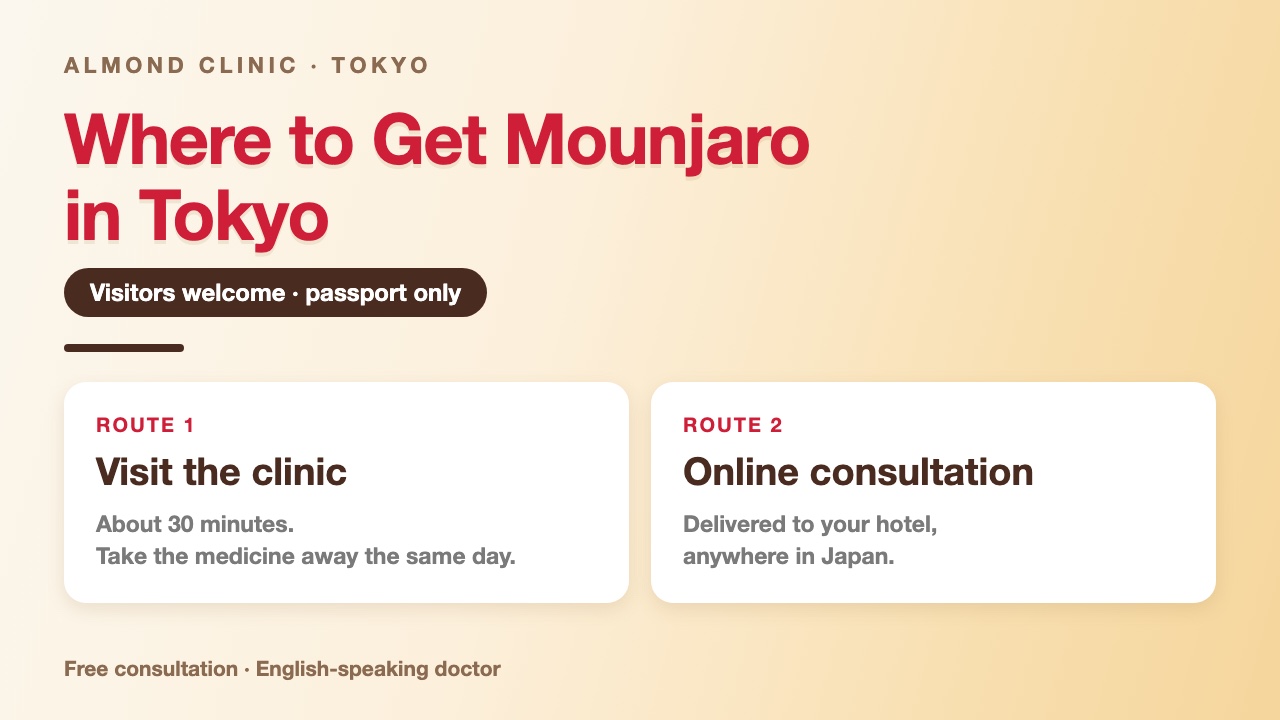
- Yes, a visitor can be prescribed Mounjaro in Japan. You do not need to be a resident and you do not need Japanese health insurance, because this is self-pay care.
- Bring your passport. That is the only document required.
- Two routes: visit the clinic and take the medicine away the same day, or have an online consultation and receive it at your hotel.
- From JPY 16,500 (≈ USD 104) a month. The consultation itself is free.
If you are visiting Tokyo and want to start Mounjaro — or you are already on it and need to bridge a gap — this page explains exactly how it works: what to bring, what happens at the appointment, how long it takes, what it costs, and what to do about the language.

Dr. Itsuki Nakayama · Medical Director, Almond Clinic
We dispense genuine brand-name medicine obtained through Japan’s regular pharmaceutical distribution channels.
Can a visitor be prescribed Mounjaro in Japan?
Yes. There is no residency requirement for self-pay medical care in Japan, and no Japanese health insurance is involved, so a tourist or business traveller is treated in exactly the same way as anyone else paying privately.
What is required is the same thing required anywhere: a doctor has to assess you before prescribing. In Japan, Mounjaro is approved as a treatment for type 2 diabetes, so using it for weight management is off-label use and is provided as self-pay care. The doctor will ask about your health, any medicines you already take, and whether the treatment is appropriate for you at all.
What you need to bring
- Your passport — the original, not a photocopy. It is used to confirm your identity.
- Payment — cash or a credit card.
- If you already take Mounjaro or another GLP-1, a note of your current dose is useful, though not essential.
- If you would like an English prescription certificate to carry the medicine home, have your home address in English ready.
You do not need a Japanese address, a Japanese phone number, a referral, or a blood test booked in advance.
Two ways to get it
Route 1: visit the clinic
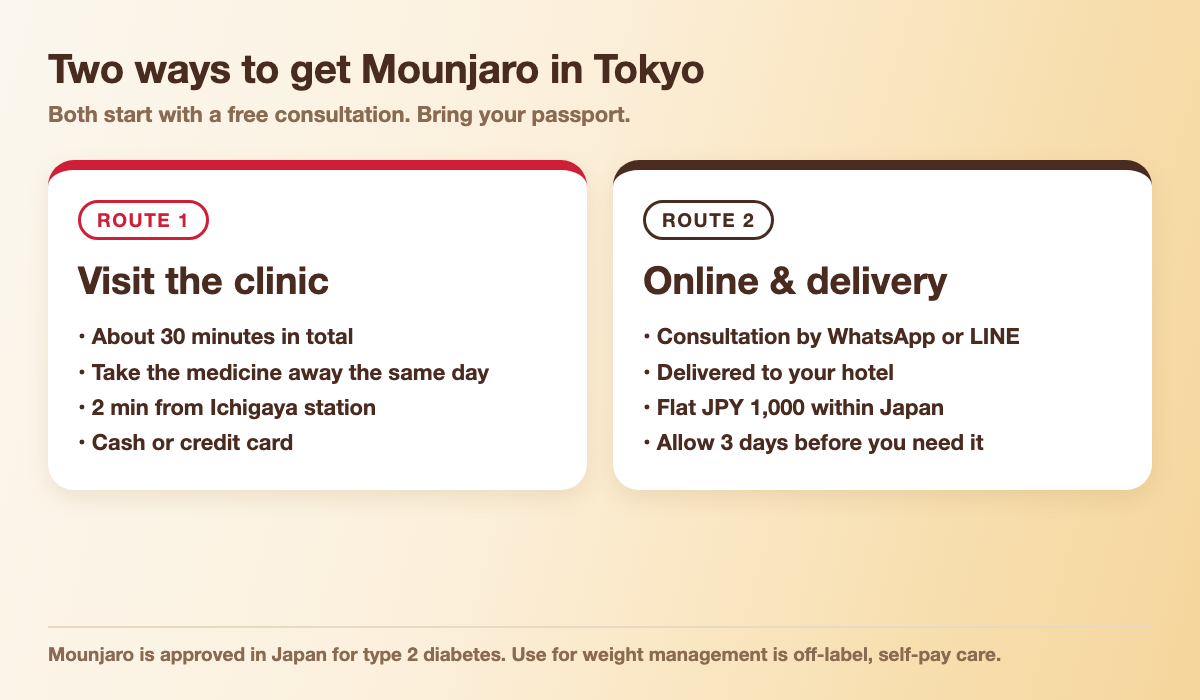
Book a time, come in, see the doctor, and take the medicine away with you the same day. The whole visit is normally about 30 minutes. This is the simpler route if your hotel is anywhere in central Tokyo — we are a two-minute walk from Ichigaya station.
Route 2: online consultation, delivered to your hotel
If your schedule is tight or you are staying outside Tokyo, the consultation can be done through our official WhatsApp or LINE account and the medicine sent to your hotel. Delivery is a flat JPY 1,000 (≈ USD 6) anywhere in Japan.
One timing point matters here: contact us at least three days before the date you want the medicine, so that the consultation, payment and delivery all fit inside your stay.
What actually happens at the appointment
- Arrive on time. We work by appointment only, so there is very little waiting — but the flip side is that late arrivals can be difficult to fit in.
- Show your passport at reception.
- Fill in a short medical questionnaire. Staff will help you in English.
- See the doctor. This is the part that decides whether Mounjaro is appropriate for you, and at what dose. Ask anything you want to here.
- Pay and collect. Cash or credit card. An English prescription certificate and an insulated cooler bag can be added if you want them.
Will language be a problem?
No. An English interpreter on our staff joins the consultation when available; otherwise we use a voice-translation tool, and staff will help you through the questionnaire. You do not need any Japanese.
The booking system can also be shown entirely in English — there is a language switch at the top right of the screen. Our English booking guide walks through each screen with screenshots.
What it costs
Prices are in Japanese yen, tax included. The consultation is free (JPY 0). One pen covers one week, so a month is four pens. The US dollar figures are approximate, for orientation only — you pay in yen and the rate moves. They are worked out at USD 1 ≈ JPY 159 (24 August 2026).
| Item | 1 month (4 pens) | 3-month plan (12 pens) |
|---|---|---|
| Mounjaro 2.5 mg | JPY 16,500 / month ≈ USD 104 | JPY 46,500 (JPY 15,500 / month) ≈ USD 292 |
| Mounjaro 5 mg | JPY 28,000 / month ≈ USD 176 | JPY 81,000 (JPY 27,000 / month) ≈ USD 509 |
| Mounjaro 7.5 mg | JPY 40,000 / month ≈ USD 251 | JPY 117,000 (JPY 39,000 / month) ≈ USD 735 |
| Mounjaro 10 mg | JPY 49,000 / month ≈ USD 308 | JPY 144,000 (JPY 48,000 / month) ≈ USD 905 |
| Mounjaro 12.5 mg | JPY 58,000 / month ≈ USD 364 | JPY 171,000 (JPY 57,000 / month) ≈ USD 1,074 |
| Mounjaro 15 mg | JPY 68,000 / month ≈ USD 427 | JPY 201,000 (JPY 67,000 / month) ≈ USD 1,263 |
| Prescription certificate in English | JPY 3,000 ≈ USD 19 | — |
| Delivery within Japan (online route) | JPY 1,000 ≈ USD 6 | — |
Doses start low and step up: almost everyone begins at 2.5 mg, which is why that row is the one most first-time patients pay. Prices in other countries are set by quite different mechanisms — there is a factual comparison in our article on bringing Mounjaro into Japan.
Where we are
- Address: 4F Ichigaya Hachimancho Building, 11-1 Ichigaya Hachimancho, Shinjuku-ku, Tokyo 162-0844
(to show a driver: 〒162-0844 東京都新宿区市谷八幡町11-1 市ヶ谷八幡町ビル4階) - Opening hours: 10:00 – 18:00, closed on Wednesdays and over the New Year holidays
- Getting here: about 2 minutes’ walk from Ichigaya Station (JR Chuo-Sobu Line), or 1 minute from Exit 7 (Tokyo Metro Namboku / Yurakucho Line, Toei Shinjuku Line)
Before you decide: what Mounjaro is and is not
In Japan, Mounjaro is approved as a treatment for type 2 diabetes. Using it for weight management is off-label use, provided as self-pay (non-insured) care. It is therefore not covered by Japanese public health insurance and not eligible for the national relief system for adverse drug reactions.
The most common side effects are gastrointestinal: nausea, vomiting, diarrhoea, constipation, reduced appetite and abdominal discomfort. These are usually mild to moderate and tend to ease within a few weeks. Rare but important side effects include acute pancreatitis and gallbladder disease, and low blood sugar can occur when it is combined with other glucose-lowering medicines. If you develop severe, persistent abdominal pain, stop using it and seek medical attention.
It is not suitable for everyone. It should not be used by anyone who is pregnant, planning a pregnancy or breastfeeding; anyone with a personal or family history of medullary thyroid carcinoma or with multiple endocrine neoplasia syndrome type 2; or anyone who has had a serious allergic reaction to any ingredient. Tell the doctor if you have a history of pancreatitis or severe gastrointestinal disease.
FAQ
- I am staying in Osaka, Kyoto or Fukuoka, not Tokyo. Do I have to travel?
-
No. The online consultation works from anywhere in Japan, and the medicine is delivered to your hotel or address in Japan (flat JPY 1,000; allow 3 days, or 14 days for Okinawa and Hokkaido). Coming to the Ichigaya clinic is only necessary if you want to collect the same day. Osaka, Kyoto, Fukuoka, Nagoya, Sapporo, Okinawa — the process is identical.
- Do I need Japanese health insurance?
-
No. This is self-pay care, so no insurance is used at all — Japanese or otherwise. You pay the listed price directly.
- How far in advance should I book?
-
For a clinic visit you can often book for the next day or two, and availability is shown live on the booking screen. For the online route, allow at least three days before the date you want the medicine in your hands.
- Can I bring a friend or my family?
-
Our waiting area is small, so please keep the number of people accompanying you to a minimum. If several of you want a consultation, that is fine — but please enter the number of patients and each person’s full name in the remarks box when you book.
- Is it tax-free like shopping?
-
No. Medicines prescribed by a doctor at a medical institution are treated differently from goods sold in ordinary shops under Japanese tax rules, and are not eligible for consumption-tax exemption or refund.
- Can I get more after I go home?
-
You can keep in touch with the doctor through our official WhatsApp or LINE account and request a further prescription. Repeat prescriptions can be delivered to an address in Japan, or collected at the clinic on your next trip.
This article is general information, not medical advice. Whether Mounjaro is appropriate for you is a decision for a doctor who has assessed you.
Related reading
- Mounjaro in Japan — our main page: full price list, the Tokyo clinic, online prescription and delivery.
- Mounjaro price in Japan — what each dose costs per month, and what is included.
- Mounjaro outside Tokyo — Osaka, Kyoto, Fukuoka, Okinawa and Sapporo by online consultation and hotel delivery.
- How to use the Japanese Mounjaro pen — three steps, and how it differs from the KwikPen.
- Is Mounjaro right for you? — who it is not for, and what to tell the doctor.
- Can you bring Mounjaro into Japan? — the one-month rule and the Yakkan Shoumei.
- Taking Mounjaro home from Japan — the rules for six destinations.
- Mounjaro side effects and the first month — what to expect, and when to stop and get seen.
Dr. Itsuki Nakayama · Medical Director, Almond Clinic
We dispense genuine brand-name medicine obtained through Japan’s regular pharmaceutical distribution channels.
