
Mounjaro Side Effects and What the First Month Really Feels Like

The short version
- Nausea is the one to expect, and it is worst in the first week and after each dose increase. It usually settles.
- The dose goes up slowly and on purpose. 2.5 mg for four weeks is a starting dose, not a treatment dose — it exists to let your gut adjust.
- Most of what makes the first month bearable is how you eat, not what you take for it.
- There is one symptom you should never wait out: severe, persistent abdominal pain. Stop and get seen.
Most pages about Mounjaro describe how much weight people lose. Very few describe what the first four weeks actually feel like, which is the part that decides whether people keep going. This page is about that.
Why the dose starts low
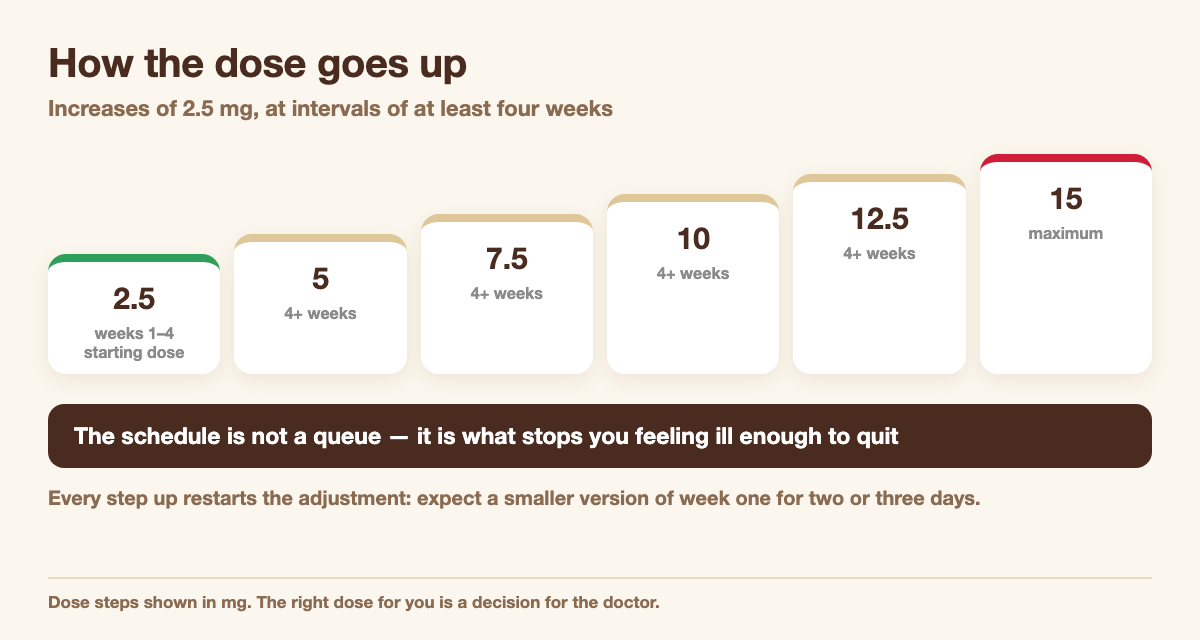
2.5 mg is not a treatment dose. It is a four-week introduction whose only job is to let your stomach and gut get used to the drug. After that, the dose rises in 2.5 mg steps at intervals of at least four weeks, up to a maximum of 15 mg.
People ask to skip ahead. It is worth being blunt about why that goes badly: the schedule is not a queue, it is the thing that stops you feeling ill enough to quit. Starting high mostly produces vomiting, and people who vomit for a week stop treatment altogether. Slower is faster here.
Every step up restarts the adjustment. If week one made you queasy, expect a smaller version of that in the week after each increase. That is normal and not a sign the dose is wrong.
What the first month usually looks like
This is a typical pattern, not a promise. People vary a great deal.
| When | What people commonly notice |
|---|---|
| First 48 hours | Often very little. Some mild nausea or a full feeling after meals. |
| Days 2–4 | Usually the peak. Nausea, early fullness, sometimes reflux or loose stools. Appetite drops noticeably. |
| Days 5–7 | Eases off for most people. Appetite stays low. |
| Weeks 2–4 | Milder each week. Constipation becomes more common than nausea, because people are eating less and drinking less. |
| After each increase | A smaller repeat of week one, for two or three days. |
If the pattern is very different from this — nausea that gets worse rather than better, vomiting you cannot keep ahead of, or pain rather than discomfort — that is worth a conversation rather than endurance.
The eating changes that actually help
Almost all of the first-month misery comes from eating the way you did before, on a stomach that now empties more slowly. Four changes do most of the work.
- Stop at “not hungry”, not at “full”. The signal now arrives late. If you eat until you feel full, you have already eaten too much, and that is what causes the evening nausea.
- Smaller meals, more often. Three large meals is the hardest pattern to tolerate in the first weeks.
- Go easy on fat and fried food. Fat is what slows stomach emptying further. A rich dinner is the single most common cause of a bad night.
- Drink more than feels necessary. Appetite loss quietly takes fluid intake with it, and most of the constipation, headaches and fatigue people report in weeks two to four is simply dehydration.
Alcohol deserves its own line. It is not forbidden, but it lands differently: it irritates a stomach that is already emptying slowly, and it is a common reason people feel unwell on the first weekend.
Protein and muscle
This is the part most weight-loss pages leave out. When weight comes off quickly, muscle comes off with the fat. Eating far less makes that worse, and appetite suppression makes eating far less very easy.
So: protein first at every meal, and keep moving — resistance work if you do it, walking if you do not. This is not general wellness advice bolted onto a drug page. It is part of the treatment, and it is the difference between losing weight and losing the wrong tissue.
When to stop and get seen
Common side effects are uncomfortable. These are different, and they are the reason this page exists.
- Severe, persistent abdominal pain, especially pain that bores through to your back and does not ease. Stop the medicine and seek medical attention. This is the symptom not to wait out — acute pancreatitis is rare but real.
- Pain in the upper right abdomen, fever, or yellowing of the eyes or skin. Gallbladder problems can occur, particularly during rapid weight loss.
- Vomiting you cannot keep ahead of, or being unable to keep fluids down. Dehydration is what turns a bad week into a hospital visit, and it can affect the kidneys.
- Signs of low blood sugar — shaking, sweating, confusion — if you also take insulin or a sulfonylurea. That combination needs the doses reviewed.
- A severe allergic reaction: swelling of the face or throat, or difficulty breathing. Emergency care.
If you are in Japan and this is an emergency, dial 119. Ambulances are free and the operator can connect an interpreter. We are a clinic, not an emergency service, and we would rather you called 119 than waited for us to open.
Practical questions people actually have
- Which day should I inject? Any day, but the same day each week. Many people pick a day where feeling flat the next evening does not matter much.
- Time of day, with or without food? Either. It does not need to be tied to meals.
- Where do I inject? Abdomen, thigh or upper arm, rotating the site each week.
- I missed a dose. It can be taken within four days (96 hours) of the scheduled day. Beyond that, skip it and resume on your normal day. Never double up.
Where this treatment stands in Japan
In Japan, Mounjaro is approved for type 2 diabetes. Using it for weight management is off-label use provided as self-pay care. It is not covered by Japanese health insurance, and it is not eligible for the national relief system for adverse drug reactions. We explain how the approved obesity medicines differ in Mounjaro, Zepbound, Wegovy and Ozempic in Japan.
FAQ
- How long does the nausea last?
-
For most people it is worst in the first two to four days after an injection and eases through the week, becoming milder with each passing month. It returns in smaller form after each dose increase. If it is getting worse week on week rather than better, that is not the usual pattern and is worth reviewing.
- Can I stay on 2.5 mg if it is working?
-
That is a conversation to have with the doctor rather than a rule. 2.5 mg is designed as a starting dose, but the right dose is the lowest one that is doing the job you need without side effects you cannot live with. Going up is not automatic.
- Is losing weight slowly a sign it is not working?
-
No. The first month is largely about tolerating the medicine, and the starting dose is not the dose most of the effect comes from. Judging the treatment on week three is judging it too early.
- I am starting while travelling in Japan. Anything different?
-
Two things. Consider which day you inject so the quietest two days are not the days you had planned a long trip or a big dinner. And plan the cold chain for the journey home — that is covered in Taking Mounjaro home from Japan.
- Can I take something for the nausea?
-
Sometimes, and the doctor can advise at your appointment. But in the first month the eating changes above do more than medication does, and they have no side effects of their own. Start there.
This article is general information, not medical advice, and does not list every possible side effect. Please read the information supplied with your medicine and raise anything that concerns you with a doctor who knows your history.
Related reading
- Mounjaro in Japan — our main page: full price list, the Tokyo clinic, online prescription and delivery.
- Is Mounjaro right for you? — who it should not be used by, and what the consultation covers.
- Where to get Mounjaro in Tokyo as a visitor — what to bring, and what it costs.
- Taking Mounjaro home from Japan — customs rules for six destinations.
