
Travelling With Mounjaro: Storage, Flights, Hotels and Time Zones
The short version
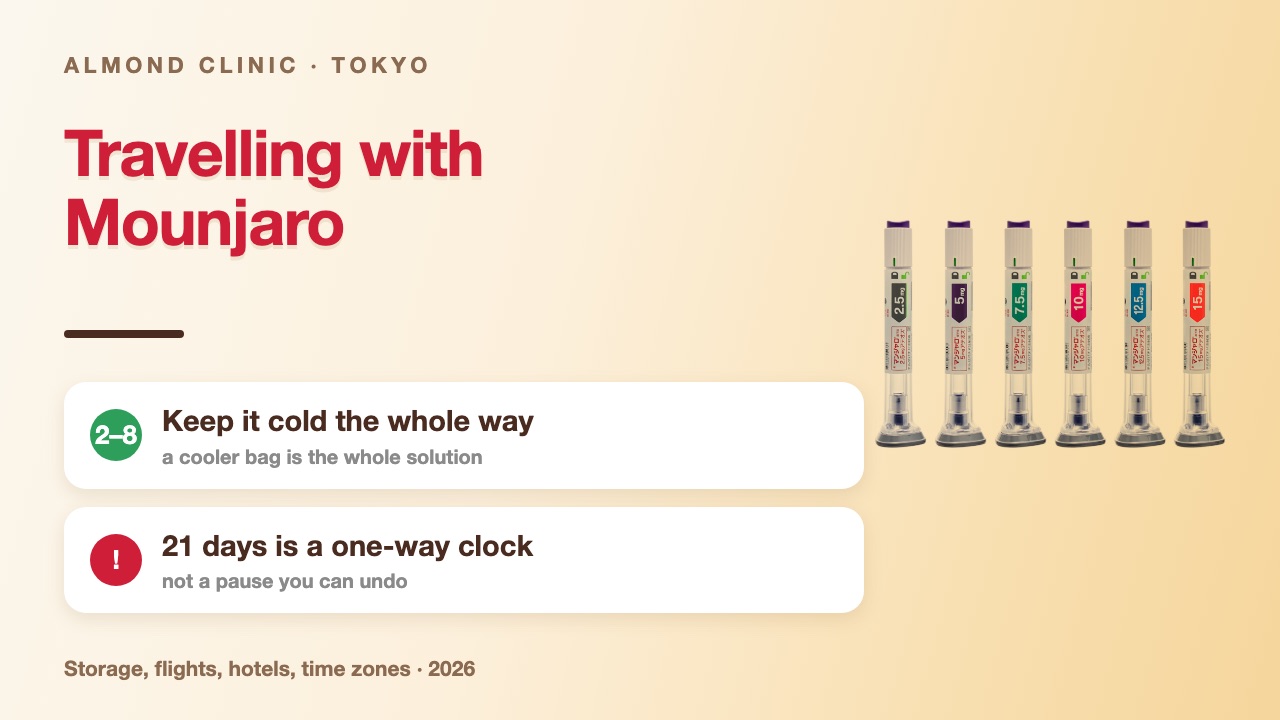
- 2–8°C is home. Room temperature is an allowance, not a second option: below 30°C, in the outer carton, used within 21 days.
- Those 21 days do not rewind. The labelling does not describe putting a warmed pen back in the fridge, so treat the clock as one-way.
- Hand luggage, always. The hold can freeze pens, and a frozen pen is finished.
- A cooler bag with a gel pack is the whole solution for a normal flight. It is not a thing you need to engineer.
This page is about keeping the medicine usable — temperature, bags, flights, hotels and time zones. It is not about customs paperwork; that is a separate question, covered in Taking Mounjaro home from Japan and Can you bring Mounjaro into Japan?
The storage rule, exactly
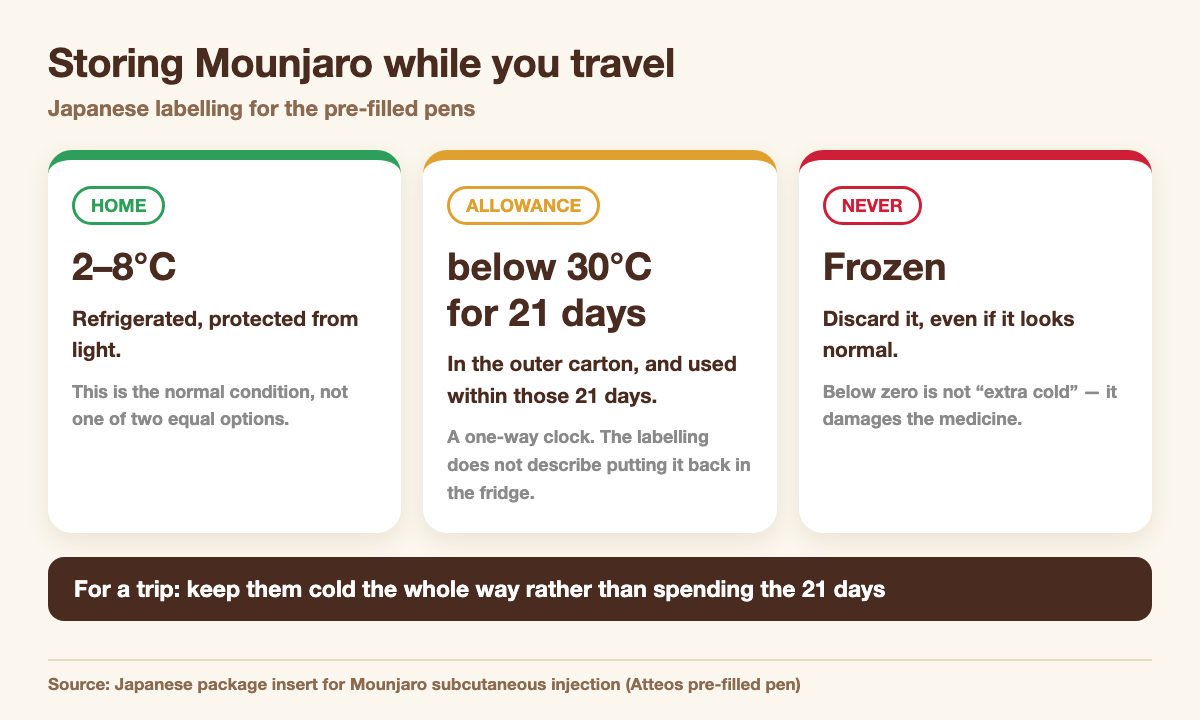
The Japanese labelling for the pens we dispense says two things:
Avoid freezing; store at 2–8°C, protected from light.
If stored at room temperature, keep below 30°C in the outer carton and use within 21 days.
Three details in there are easy to miss.
- “In the outer carton” is part of the instruction, not packaging advice. The pens are light-sensitive. Do not decant them into a pill case.
- 21 days is a use-by window, not a pause button. Once a pen has been at room temperature, plan to use it inside that window. The Japanese labelling does not describe returning it to the fridge, and Lilly’s guidance in other markets says not to.
- Freezing is absolute. Below zero is not “extra cold”; it damages the protein. A pen that has frozen must be discarded even if it looks normal.
Which leads to the practical conclusion: for a trip, keep them cold the whole way rather than spending the 21 days.
What to actually carry them in
An insulated bag with a gel pack. That is the answer for a flight of any normal length, and the two mistakes people make are opposite ones.
- Too little: a soft pouch with no cold source. Fine for an hour, useless for a day of travel in summer.
- Too much: a frozen brick pressed against the pens. This is how people freeze their own medicine. Wrap the gel pack, or keep a layer between it and the pens, and never let them touch directly.
Keep the pens in their outer carton inside the bag, with the pharmacy label intact — that also happens to be what makes a customs conversation short. We keep cooler bags at the clinic for patients who are flying, so this is not something you need to solve before you arrive.
At the airport and on the plane
- Hand luggage. Never the hold. Two reasons and both are fatal: the hold can drop below freezing, and checked bags get lost. A lost bag is a lost month of treatment.
- Take them out at security and say what they are. Injectable medicines, needles and medically necessary gel packs are permitted in carry-on and are exempt from the usual liquid limits when declared for separate screening. Declaring turns a question into a formality.
- Carry the paperwork with the medicine, not in another bag. A prescription or an English prescription certificate, in the same pocket as the pens.
- Do not put them in the seat pocket and forget them. Obvious, and it happens on every long flight.
Hotel fridges are not fridges
This is the failure people do not see coming. A hotel minibar is often a thermoelectric cabinet, not a refrigerator, and many sit around 12–15°C. Some, unhelpfully, have a freezing spot right by the cooling plate.
- Do not assume. Check. If the drinks inside are merely cool rather than cold, it is not holding 2–8°C.
- Do not push the pens to the back against the cold plate, which is where freezing happens.
- Ask the front desk. Many hotels in Japan will store medicine in a proper refrigerator on request. “Kusuri o reizōko de azukatte itadakemasu ka?” — may I leave medicine in your refrigerator? Most staff deal with this more often than you would think.
- Or simply run the 21 days. A one-week trip inside a 21-day allowance, below 30°C, in the carton, is entirely within the labelling. Just do it deliberately rather than by accident, and note the date you started.
Time zones and your injection day
Simpler than people expect. Mounjaro is weekly, and the time of day does not matter — with or without food, morning or night. So a time-zone change does not require a plan.
- Keep the same day of the week, in whatever local time you are in. A few hours either side is not meaningful for a weekly medicine.
- If you want to move your injection day permanently, that is allowed as long as there are at least three days between doses. Move it once, then keep the new day.
- Missed it while travelling? It can be taken within four days (96 hours) of the scheduled day. After that, skip it and resume on your normal day. Never take two to catch up.
If something went wrong
| What happened | What to do |
|---|---|
| It froze, or you think it might have | Discard it. Freezing damages the medicine and you cannot tell by looking. |
| Left out below 30°C for a few days | Within the 21-day allowance. Use it inside that window and note the date. |
| Left somewhere hot — a car, direct sun, above 30°C | Do not use it. Ask a pharmacist or doctor rather than guessing. |
| Out of the carton in daylight for a long period | Ask. The light instruction is there for a reason. |
| Bag lost with the pens in it | You need a new prescription where you are. We cannot post medicine abroad. |
When in doubt, ask rather than inject. A wasted pen costs money; a degraded one costs you a month of not knowing whether the treatment is working.
FAQ
- Does Mounjaro have to be refrigerated?
-
Normally yes — 2–8°C, protected from light. The labelling also allows room temperature below 30°C, in the outer carton, used within 21 days. Treat that as a one-way allowance for travel rather than as an alternative way to store it.
- Can I put it back in the fridge after a trip?
-
Do not count on it. The Japanese labelling does not describe returning a room-temperature pen to the refrigerator, and Lilly’s guidance in other markets says not to. Plan to use it within the 21 days instead — or keep it cold throughout so the clock never starts.
- Will airport security take my needles?
-
No, when they are carried with the medicine they belong to. Needles, injectable medicines and medically necessary gel packs are permitted in carry-on. Take them out before screening and say what they are.
- How long will a cooler bag hold temperature?
-
It depends entirely on the bag and the gel pack, so no honest single number exists. What matters is that you do not need it to last forever — you need it to cover the journey, and anything beyond that is covered by the 21-day allowance.
- Can you post my next month to me at home?
-
No. Repeat prescriptions can be delivered to an address within Japan, or collected on a later trip. Sending prescription medicine across a border is treated as importing, and is governed by the receiving country’s rules rather than ours.
This article is general information, not medical advice. Storage instructions can differ between products and markets — please follow the leaflet supplied with your own medicine, and ask a pharmacist or doctor if a pen has been outside those conditions.
Related reading
- Mounjaro in Japan — our main page: full price list, the Tokyo clinic, online prescription and delivery.
- Taking Mounjaro home from Japan — the customs rules for six destinations.
- Can you bring Mounjaro into Japan? — the one-month rule and the Yakkan Shoumei.
- Where to get Mounjaro in Tokyo as a visitor — what to bring, and what it costs.
