
Which Weight-Loss Injection Can a Visitor Actually Get in Japan? Mounjaro, Zepbound, Wegovy and Ozempic
The short version
- What a visitor can realistically get: Mounjaro, prescribed off-label for weight management as self-pay care. The obesity-licensed products are usually out of reach on a short stay — see below.
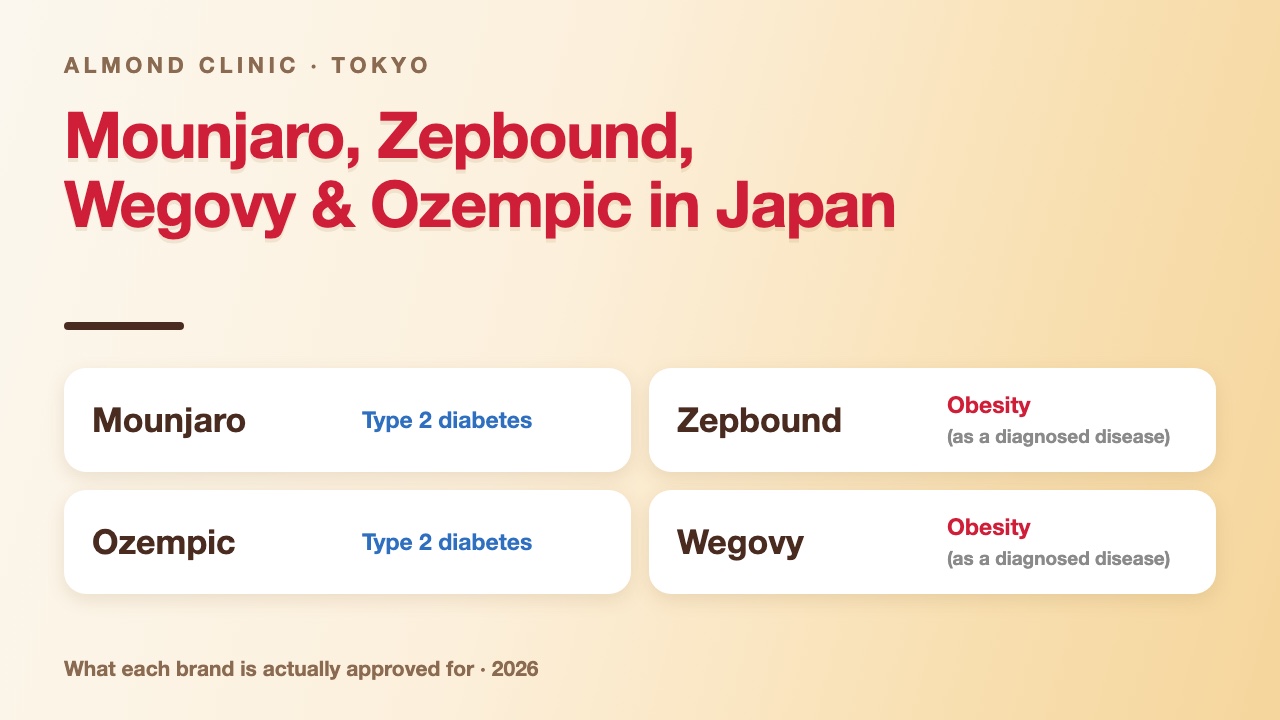
- In Japan, Mounjaro and Zepbound are the same molecule (tirzepatide) sold under two names. Mounjaro is approved for type 2 diabetes; Zepbound for obesity as a diagnosed disease.
- The same split applies to semaglutide: Ozempic for type 2 diabetes, Wegovy for obesity.
- The obesity medicines carry national “optimal use” guidelines with BMI thresholds, required complications and facility requirements. A short visit to Japan will not normally meet them.
If you are visiting Japan and wondering which weight-loss injection you can actually be prescribed, the honest answer is narrower than the list of approved names suggests. Four products are approved here — Mounjaro, Zepbound, Wegovy and Ozempic — but the two licensed for obesity come with conditions a short-stay visitor will rarely meet. This page explains what each one is approved for, why that matters at a Tokyo clinic, and what you will realistically be offered.

Dr. Itsuki Nakayama · Medical Director, Almond Clinic
We dispense genuine brand-name medicine obtained through Japan’s regular pharmaceutical distribution channels.
What is approved in Japan, and for what
| Brand | Active ingredient | Approved in Japan for |
|---|---|---|
| Mounjaro | Tirzepatide (GIP / GLP-1) | Type 2 diabetes |
| Zepbound | Tirzepatide (GIP / GLP-1) | Obesity as a diagnosed disease (approved 27 December 2024); later also obstructive sleep apnoea |
| Ozempic | Semaglutide (GLP-1) | Type 2 diabetes |
| Wegovy | Semaglutide (GLP-1) | Obesity as a diagnosed disease (approved 27 March 2023) |
Two things in that table surprise most visitors.
Same molecule, two names
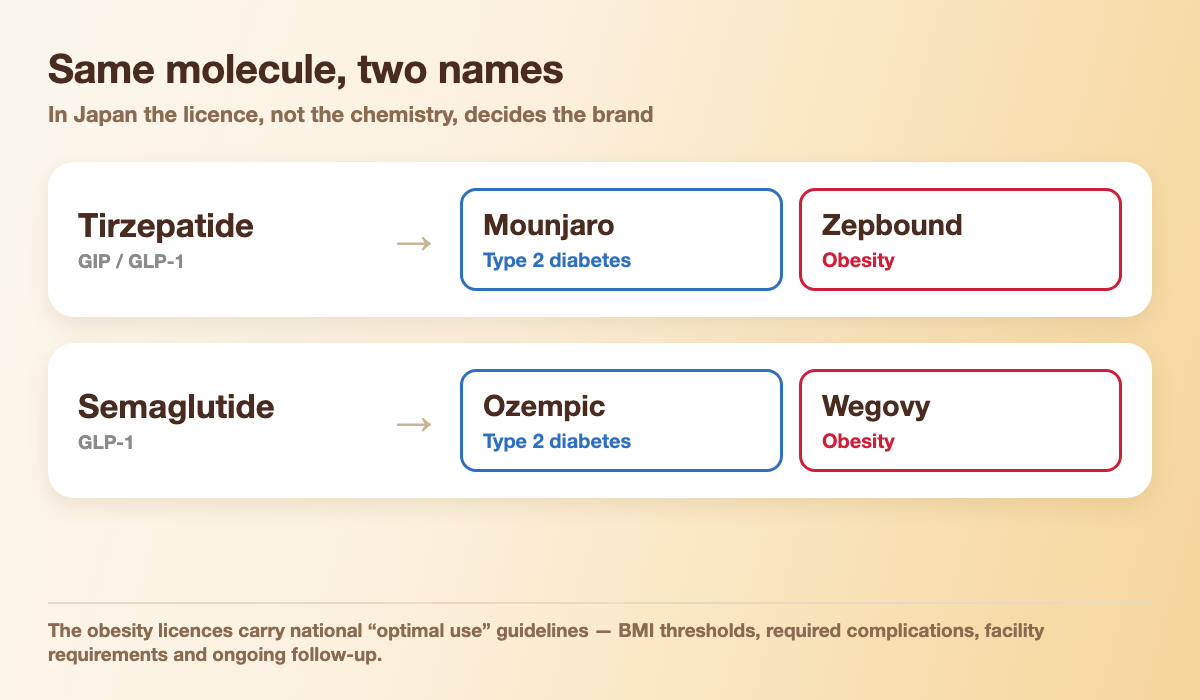
Mounjaro and Zepbound contain exactly the same active ingredient, tirzepatide. They are separated not by chemistry but by licence: one is registered for diabetes, the other for obesity, with different dosing schedules and different rules attached. Ozempic and Wegovy are separated in the same way, both being semaglutide.
This is why a patient can be told, quite correctly, both that “tirzepatide is approved for weight management in Japan” and that “Mounjaro is not approved for weight management in Japan”. Both statements are true at once.
Why the obesity licences are hard for a visitor to use
Japan does not simply approve these medicines and leave prescribing to the market. Both Wegovy and Zepbound are covered by “optimal use promotion guidelines” issued by the Ministry of Health, Labour and Welfare, which set out who may be treated and where.
For Zepbound, the patient must have hypertension, dyslipidaemia or impaired glucose tolerance, must have already tried diet and exercise therapy without sufficient effect, and must have either:
- a BMI of 35 or above, or
- a BMI of 27 or above together with two or more obesity-related health problems.
Wegovy is governed by a guideline of the same kind. On top of the patient criteria, both guidelines place requirements on the facility and the prescribing doctor, and both assume continuing management — documented diet and exercise therapy, follow-up, monitoring.
Read that list as a traveller and the problem is obvious. A documented history of failed diet and exercise therapy in Japan, and ongoing follow-up here, are not things a two-week trip can produce. The obesity licences are built for patients under long-term care in the Japanese system, not for visitors.
You can read the guidelines themselves on the PMDA website: Zepbound (obesity) and Wegovy (obesity). Both are in Japanese.
So which one can a visitor actually get?
In practice, Mounjaro prescribed off-label as self-pay care. That phrase is worth unpacking, because it is not a loophole and it is not unusual:
- Off-label means the doctor is prescribing an approved medicine for a purpose outside its registered indication, on their own clinical judgement. It is lawful and common in medicine worldwide.
- Self-pay means no insurance is involved. You pay the clinic’s price directly — which is also why a visitor with no Japanese insurance is not at any disadvantage.
- Because it sits outside the insurance system, it is not eligible for Japan’s national relief system for adverse drug reactions. That is a real trade-off and you should know about it before you start.
The medicine itself is the ordinary Japanese-market product, obtained through Japan’s regular pharmaceutical distribution channels.
If you are already on a GLP-1 at home
Two practical points, both of which catch people out.
Switching between molecules is a medical decision, not an administrative one. Semaglutide and tirzepatide are not interchangeable dose-for-dose, and a doctor will want to know what you are on, at what dose, and for how long before advising anything.
Bringing your own supply into Japan has its own rules. One month’s supply is allowed without paperwork; more than that requires a certificate obtained before you fly. We cover this in detail in Can you bring Mounjaro into Japan?
Safety information
The most common side effects of tirzepatide are gastrointestinal: nausea, vomiting, diarrhoea, constipation, reduced appetite and abdominal discomfort. These are usually mild to moderate and tend to ease within a few weeks as the body adjusts to the medicine or to a higher dose. Rare but important side effects include acute pancreatitis and gallbladder disease, and low blood sugar can occur when it is used together with other glucose-lowering medicines. If you develop severe, persistent abdominal pain, stop using it and seek medical attention.
It should not be used by anyone who is pregnant, planning a pregnancy or breastfeeding; anyone with a personal or family history of medullary thyroid carcinoma or with multiple endocrine neoplasia syndrome type 2; or anyone who has had a serious allergic reaction to any ingredient. Tell the doctor if you have a history of pancreatitis or severe gastrointestinal disease.
FAQ
- Can I get Zepbound or Wegovy as a visitor?
-
In practice, no. Both are governed by national optimal-use guidelines that require a documented obesity diagnosis with specific BMI thresholds and complications, evidence that diet and exercise therapy has already been tried, requirements on the treating facility, and continuing follow-up. A short stay cannot satisfy those conditions.
- Is Mounjaro the same as Zepbound?
-
They contain the same active ingredient, tirzepatide. They are marketed under different names with different approved indications and different dosing schedules. They are not two different drugs.
- Is Saxenda available in Japan?
-
Saxenda is not approved in Japan. Liraglutide is available here under a different brand for type 2 diabetes, but not under the Saxenda licence for weight management.
- Does “off-label” mean it is unapproved or unregulated?
-
No. The medicine is approved and licensed in Japan and comes through normal pharmaceutical distribution. “Off-label” describes the purpose it is being prescribed for, not the medicine’s status. What it does mean is that the treatment sits outside the insurance system and outside the national adverse-reaction relief system.
This article is general information, not medical advice, and approval status and guidelines change. Please check the current position with the Japanese authorities, and discuss your own situation with a doctor.
Related reading
- Mounjaro in Japan — our main page: full price list, the Tokyo clinic, online prescription and delivery.
- Is Mounjaro right for you? — who it is not for, and what to tell the doctor.
- Where to get Mounjaro in Tokyo as a visitor — what to bring, and what it costs.
- Mounjaro in Japan for foreign residents — insurance, repeat prescriptions and travelling home.
- Mounjaro side effects and the first month — what to expect, and when to stop and get seen.
Dr. Itsuki Nakayama · Medical Director, Almond Clinic
We dispense genuine brand-name medicine obtained through Japan’s regular pharmaceutical distribution channels.
